Back to His Roots: David Mearns Gets Back on the Brush at 50

With a career spanning many facets of sign-making, Signmode has taken David Mearns back to where it all started with no regrets. Ahead of Mearns’ return to The Sign Show, Sam Roberts speaks to this traditional signwriter.


When David Mearns picks up the phone for our conversation, he’s in the middle of paying bills and other bookkeeping tasks. These now come naturally to him after more than 40 years in the business of signs, but it wasn’t always so; in his teenage years he “was awful at maths” and finished school with just two O Levels in Art and Technical Drawing. However, his success in those subjects was perhaps inevitable for someone that “always had a pencil in [his] hand and was constantly drawing”. He’s now wielding a pencil once again, alongside the brush that is the main tool of his trade – traditional signwriter.


Seeking (and Finding) Direction


Although he was born in The Wirral, Merseyside, David grew up in Surrey and after getting those O Levels as a 16-year-old, he had no idea what he was going to do next. One day while walking in Guildford with his dad they happened upon a signwriter lettering a shop fascia. As they paused to watch him work, David’s dad casually remarked: “You could do that”

A seed had been sown and, not long afterwards, a school friend mentioned that the local Guildford Signs firm was looking for an apprentice. David’s mum drove him to their shop, where she was also invited inside and given a cup of tea in the waiting room while he got interviewed. Up against 20 other hopefuls, he got the position and started work in July 1985.


Formative Years


Guildford Signs provided David with a traditional apprenticeship, an opportunity that is largely closed to today’s aspiring signwriters.


The vast majority of the firm’s work was hand-painted, and he was quickly making himself useful around the shop. His early responsibilities included coating out boards before they were lettered by the signwriters, and later he progressed onto double coating larger letters, gradually developing his skills, even though he didn’t feel like he was making progress.


Despite having only one working eye, the boss, Mark Allen, was a fine signwriter, and nothing like the grumpy taskmaster stereotype of shop foremen. One day he saw David admiring some skilful lettering work in progress and offered up some encouraging words: “One day with practise, you’ll be doing this”, and, sure enough, it came to pass.


David worked at Guildford Signs for the best part of eight years, with most of this in the era when everything was done by hand. From fascia signs to vehicles, the shop covered all the traditional aspects of signwriting and gilding, and he emerged as a well-rounded ‘sign man’.


Embracing Technology


One of David’s mottos is “never stop learning” and, while traditionally trained, he spent the next 25 years or so working across a range of different sign-making disciplines and technologies.


From extra-large dimensional letters and illuminated signs to vinyl and vitreous enamel, he continued to add new skills and techniques to his repertoire. Rather than resisting new technologies like large-format printing, he was driven to learn how they worked and which applications they were best suited to.


In addition to design, fabrication, and installation work, David also spent time in project and production management roles, developing his understanding of pricing, scheduling, and customer services. He was often working with blue chip clients, learning how they operate and what they need from the sign shops that serve them. Throughout all of this, his curiosity was a driving force, consistently seeking new experiences that built the knowledge required to solve problems and recommend the best approaches for different customer requirements.


Back to the Future


After an extended period of time commuting from the mainland to the isle of Wight for his last employer, David began to feel an overwhelming desire to go it alone and, in doing so, return to his signwriting roots.


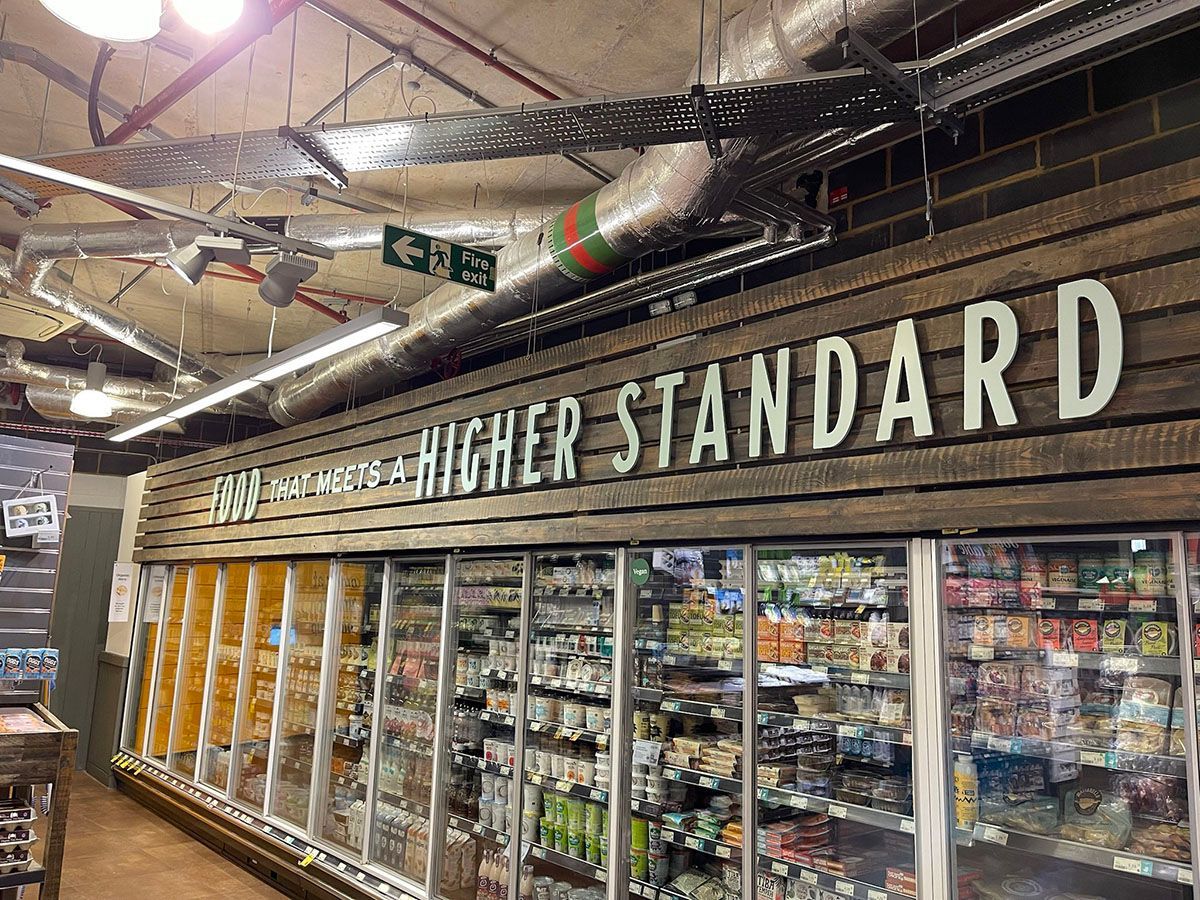
This came to a head in early 2020 and, although unconnected to the onset of the Covid-19 pandemic, he set up his current business, Signmode, in February of that year. Based in Worthing, West Sussex, Signmode is a full-service shop, but the vast majority of its output is 100% hand painted. Most of this is subcontracted from larger sign firms, with a smaller portion comprising local, private clients.


David has relished this new direction and his passion for the craft is felt by his loyal and growing clientele. He has been able to draw on his decades of industry experience to quickly build a thriving business doing what he loves. He credits another technology – LinkedIn – as a solid marketing platform, alongside his existing network and word-of-mouth recommendations.


His work now takes him all over the country, with pre-dawn starts not uncommon, but doing it for himself, which makes it all worthwhile. While speaking with him, he was in the middle of a project that required renting temporary space at Brighton City Airport to accommodate a series of hand-painted safety screens for a 140m-tall student accommodation building in Canary Wharf. Some of these measure 14 × 7m, with their efficient production facilitated by the use of mask and spray techniques – “It’s all about finding the best way to deliver what the client needs, not forcing a brush into situations where it isn’t necessary,” says David.


Passing It On


After the 2020 shift in his career direction, David had another epiphany in 2022. This came after attending a four-day reverse glass gilding course in Torquay, Devon, taught by master craftsperson David Adrian Smith MBE.


Driving back to Worthing, with his head full of the possibilities emerging from this intensive learning experience, he decided that he wanted to add teaching to his own activities. The result is The Sign Painter and its monthly workshop for those that want to learn some signwriting basics. With groups capped at four people, the hands-on day takes them through the basics, including tools and materials, brush control, and transfer techniques, with each participant taking home a finished personal project.

The workshop is a long way from the years-long apprenticeship that David served, but most of his students are essentially hobbyists or those looking to get off their screens and do something with their hands. However, there are often some that have a degree of natural talent and David is actively considering taking on an apprentice of his own one day. And the lucky person will likely pick up a lot more than the technical skills needed to be a signwriter, including that all-important number crunching that makes it pay.


Taken from the featured article on the Signlink website here.
By David Mearns December 16, 2024
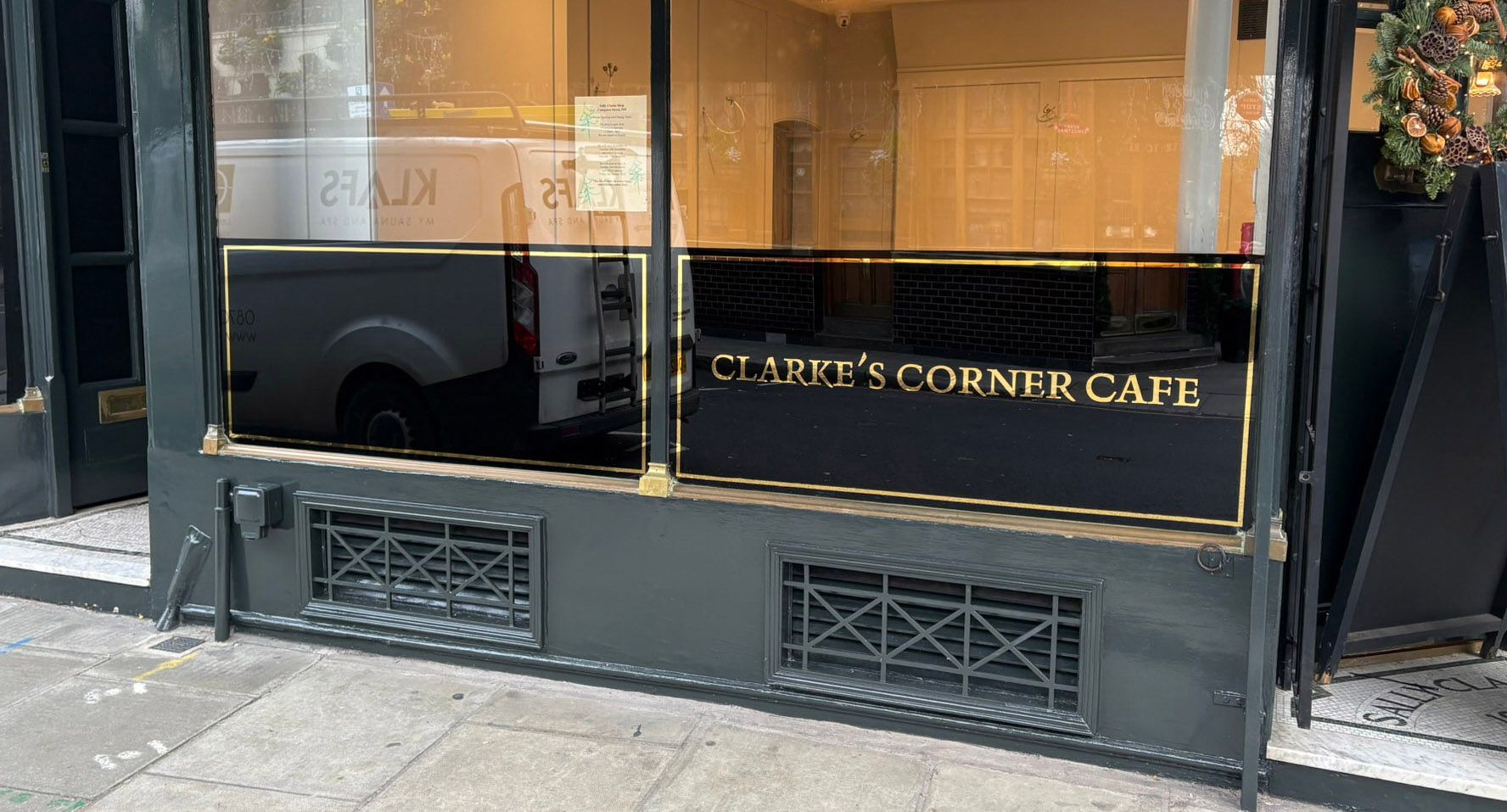
A new client last year gave us the opportunity to do some gilding for an art gallery in St James Square, London. Recently we have also hand painted some large yellow suns in Marylebone and Notting Hill in memory of a famous café owner. Then we were asked to work at Sally Clarke’s in Kensington. This is a coffee shop, selling all hand made food and pastries and they have a restaurant over the road. This month is 40 years since the shop was set up and they are opening a café on the corner. We were asked to water gild lettering and lines on 4 windows with 2 sets of lettering – Clarke’s Corner Café. Removal of existing gold leaf and back painted glass, although sad enabled the new designs for the windows to be started. Lots of glass cleaning and scraping, both sides of course so no errors are made assuming a blemish is on the outside, then it isn’t! We used a different approach with these designs as the coachline was at its longest 1700mm. We applied removable vinyl lines and lettering to the glass and then painted over this in gloss paint. While it was drying, within 30 mins we removed the vinyl leaving clear glass. The next day, when all dry, we degreased the clear glass again and started gilding the clear lines. Carefully cutting each loose leaf into 4 we could then carefully lift these onto the glass that we have just dripped the gold size onto. Bearing in mind, each gold leaf cut into 4 lengths covered approximately 320mm. This is a process that just cant be rushed as even the slightest breath can blow the gold leaf off the gilding pad or even if someone opens a door! Normally this process would involve gilding straight onto the glass then signwriting the letters and detail over the back, cleaning off the surrounding gold then back paint over all this. Some people are against using modern technology with old processes, but I truly believe that if it achieves the end result and a better result then why not. Gilding these lines was a real task, knowing that the next day we had to gild them again to cover any gaps. It does play with your head a bit as its such a long process where in some cases you can’t see the end. However, when done again and you walk outside and see the solid gold finish, it gives so much satisfaction especially when the public ask and comment how beautiful it all is. The 3rd day was finishing off the lines and then gilding the letters, twice of course. 4th and final day was to burnish all the gold, checking for any gaps. It was handy getting to site at 630am in the dark so with the lights on inside it made it easier to spot any. We then marked these with tape and gilded. Turning up the heating in the shop allowed the gold to dry quick. Final job was to mask up all round and then repaint all over each design in gloss black, laying off vertically so no runs. Water gilding is a slow process that can’t be rushed, it can be painful when gilding with gaps and gold blowing in the slightest breeze, but when finished gives so much pleasure to myself seeing the end result that will be there for years to come. Satisfactions is guaranteed. 😊
Hand painting on to brick at Pret. The Sign Painter.
By David Mearns November 1, 2024
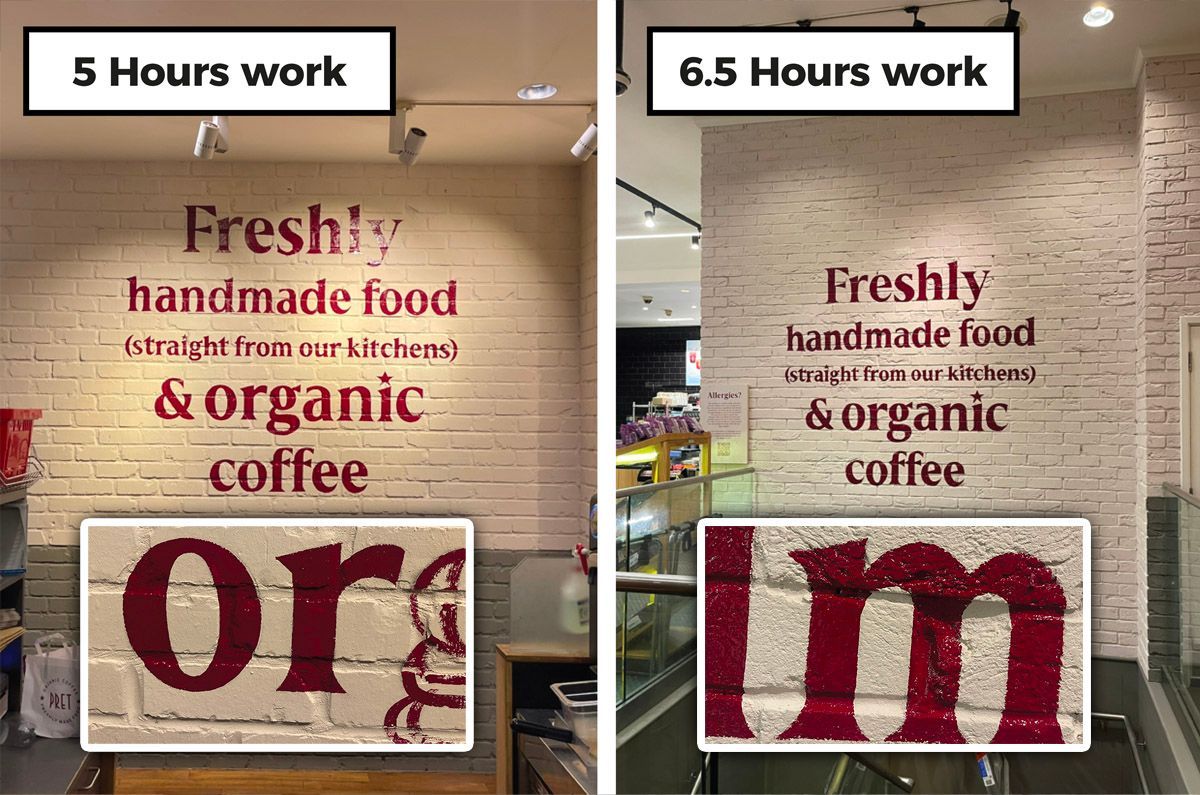
Having the opportunity to work with Pret doing all the signwriting for their Southern outlets, we soon realised how they loved signwriting on painted brick. These projects involve smaller 100mm letters up to 200mm letters painted onto brickwork. We use our paper pounce that is an outline of the letters with holes and use a pounce pad that is filled with charcoal or chalk that we rub over the drawing and it transfers the outline for us to follow. Now, these bricks aren’t real, they are brick slips, fibreglass and in some cases very distressed. They are not like old painted brick that becomes smooth with paint over the years. Using a brush over the brick gives a very rough outline of where and how the letter is formed and then we use a very small, and in some cases a tired old 3mm long brush to then fill in and push the paint into the gaps. This can take time. Lots of these Pret jobs are refurbishments so they are open during the day and we work at night and so you have to finish what you started, there is no chance of leaving half a message! One particular message, 5 lines of letters took me 5 hours to signwrite, total commitment to the job in hand, the trick is to focus and relax. Something not that easy with sciatica but a conversation with my wife, taking my mind off pain helped immensely. Signwriting is a very intimate thing – as it's just you, a brush and a wall, and the world carries on behind you as it does on these jobs with people doing other works or installing signs. At the end of the night, you can look back and admire what you have achieved and soak up all the nice comments you received while signwriting. Then, there is the 6½ hour brick. This is exactly the same message, same size, colour and 5 lines of text, the only difference is the brick. On this wall the brick is very open and porous and therefore when signwriting, the outline of the letter only puts a small amount of paint down which means more filling in with the old tired brush! I was there all night on this and so it didn’t matter. However, one thing worth remembering when pricing this type of work is that not all bricks are the same and if you are not able to see the brick type then allow for the worst case scenario, I teach this to my students all the time. The smaller lettering, normally in blue, with a red star can take 2-3 hours. The other week when on a Pret job I was told I have ‘patience of a saint’ and I agree. 😊
The appreciation of a sign
By David Mearns November 1, 2024
Nowadays we have so much at our fingertips that we are completely spoilt. I truly believe that a lot of new people entering the industry may think that it has always been this way and that we have always had routers, font finders, colour matching systems, rolls rollers and digital printers, just to name but a few. If only this was the case. I refer to it when on social media where someone was asking what the name of a particular font was. I had a look and after a few moments I remembered back to my signwriting days and recognised the font as Modern No20. Then I thought I wonder how many other people could recognise fonts. Different, when in the design industry as you are using them to create the design. But in the sign industry nowadays you see them every day, but do you know what they are. In fact with the speed of works going through on a daily basis, do people really care? There are websites now capable of recognising a font! I remember in the late 80’s looking back through a letraset book to find a font, sometimes this would take an hour or more just so we could then draw it up, by hand of course or but in some letraset and enlarge with an epidiascope. After speaking with some colleagues, not quite as old as me the other day, we said that it would be interesting if you demonstrated how signs used to have lettering applied. Not going back to signwriting but applying vinyl lettering using a scaled drawing that was done off the vinyl machine software or off the clients artwork using a scaled ruler or working out the factor. I am sure they would be amazed at how long this would take compared to applying a digital print with a rolls roller. So that also made me think of how we make signs, flat panels easy, if you have the appropriate wall saw or flatbed saw. I do remember cutting many a foamex panel by hand and have the scars to prove this. But again with the introduction of routers for cutting letters and shapes and now the amazing and extremely fast Kongsberg cutting tables, this enables extremely quick turnaround of products with excellent edge finishes. 3 dimensional signs have also come on with the introduction of automatic letter builders for 3 dimensional letters, this eliminates the use of bending and shaping the letter by hand and therefore enabling a quicker turnaround. Again over the years I have seen how this has been done by hand and appreciate the skill involved. Don’t get me wrong many companies still make them this way successfully and may not even entertain the automated option. So, it is all about appreciation, there are some companies that aren’t lucky enough to have such modern technology and some that wouldn’t even go near it. They are just happy with what they have as it works for them and has done for years. Next time you make a sign, take a moment to think about what the sign means to you, means to the client and more importantly what went in to making the sign as it could have taken 30 minutes or 30 hours depending on how you made it and what skills and technology was used.
More Posts